


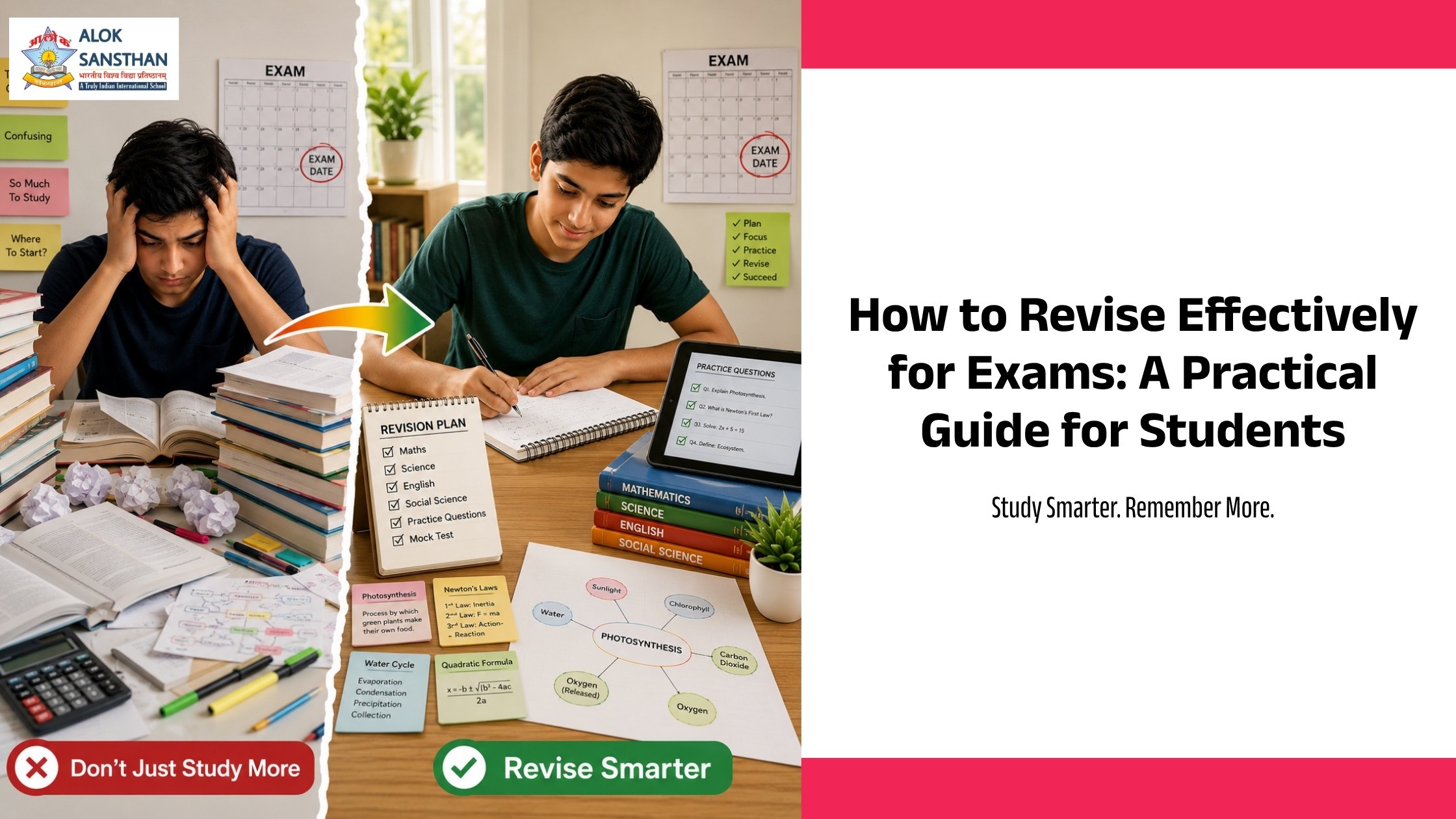

You have read the same chapter twice. You remember the page where the answer was written but when you close the book you cannot explain it clearly. Then you start reading it again. This happens to many students during exam time.
The problem is often not a lack of effort. It is the way revision is done.
Effective revision is not about studying for the longest number of hours. It is about using methods that make your brain recall information, find weak areas and practise what you have learned. The right revision techniques can also make study time less stressful and more productive.
If you are wondering how to revise effectively for your next exam this guide will help you build a simple revision routine that you can actually follow.
What Does Effective Revision Actually Mean?
Effective revision means checking what you really remember instead of simply reading the same information again.
When you read a chapter several times it may start to feel familiar. You may think you know it because the words look easy when they are in front of you. But an exam does not give you the book. You have to bring the information back from memory and use it in an answer.
That is why active revision is more useful than simply rereading.
| Passive Revision | Active Revision |
| Reading notes again | Trying to recall information |
| Highlighting large sections | Answering questions |
| Looking at solutions | Solving problems yourself |
| Feeling that a topic is familiar | Checking what you can remember |
| Spending equal time on every topic | Giving more time to weak areas |
Good revision should help you:
- Remember important information
- Understand difficult concepts
- Find topics you need to work on
- Practise answering questions
- Feel more prepared for the exam
The goal is not to remember every word in your textbook. The goal is to understand the topic and remember the information you need to use.
When Should You Start Revising for Exams?
One of the best revision tips for students is simple: do not wait until the last few days if you can start earlier.
Starting early gives you time to revise a topic more than once. It also gives you a chance to discover weak areas before exam pressure becomes high.
Your approach can change depending on how much time you have.
Four weeks before the exam: Divide the syllabus into smaller topics. Study and revise a few topics each day.
Two weeks before the exam: Spend more time on difficult chapters. Start using practice questions and past papers.
Seven days before the exam: Focus on weak areas and important topics. Use active recall and practice testing instead of spending hours rereading.
One day before the exam: Review key information, formulas, definitions and mistakes. Do not try to learn the entire syllabus from the beginning.
Even if you have started late there is no need to panic. A focused plan is better than spending hours worrying about how much work is left.
How to Make an Effective Revision Plan
A simple revision plan for exams can help you use your time wisely. You do not need a complicated planner. A notebook or simple calendar can be enough.
List Your Subjects and Topics
Write down every subject you need to revise. Break large chapters into smaller topics. This makes the syllabus feel more manageable.
Find Your Strong and Weak Areas
Ask yourself which topics you can answer without looking at your notes. Mark topics that you find difficult.
Prioritise Difficult Topics
Do not spend most of your time revising topics that you already know well. Give extra time to areas where you make mistakes.
Decide How Much Time Each Topic Needs
A difficult chapter may need several short revision sessions. An easy topic may need less time.
Add Regular Revision Sessions
Do not revise a topic once and forget about it. Come back to important topics after a gap.
Leave Time for Practice
Your plan should include practice questions, tests and past papers. Revision is not complete until you check whether you can use what you have learned.
7 Effective Revision Techniques for Students
There are many revision techniques but you do not need to use all of them. Choose methods that match the subject and the problem you are trying to solve.
1. Active Recall
Active recall is the process of bringing information back from memory without looking at your notes.
It is simple to try. Read a small section then close your book. Ask yourself what you remember. You can write the answer, explain it aloud or answer a few questions.
For example if you study photosynthesis close your book and explain the process in your own words. Then open your notes and check what you missed.
Works best for: Facts, definitions, concepts and processes.
Common mistake: Looking at your notes after only a few seconds. Give yourself time to think.
2. Spaced Repetition
Spaced repetition means reviewing information at different times instead of trying to learn everything in one long session.
You could revise a topic today then review it after two days. Come back to it again a week later.
This gives you several chances to remember the same information.
Works best for: Formulas, vocabulary, definitions, dates and facts.
Common mistake: Leaving every revision session until the final week.
3. Practice Testing
Practice testing means testing yourself before the actual exam.
Use chapter questions, quizzes or questions that you create yourself. Try to answer without checking your notes first.
When you check your answers do not only count your marks. Look at your mistakes. They tell you what you should revise next.
Works best for: Checking understanding and exam readiness.
Common mistake: Looking at the answer before making a proper attempt.
4. Past Papers
Past papers are useful because they give you practice with exam-style questions.
Start by trying the paper without your notes. Once you finish check your answers and write down the questions you found difficult.
You can then revise those topics and attempt similar questions again.
Works best for: Exam practice and applying knowledge.
Common mistake: Solving past papers without reviewing your mistakes.
5. Feynman Technique
The Feynman technique is a simple way to check whether you really understand a topic.
Choose a topic and explain it as if you were teaching it to a younger student. Use simple words. If you get stuck you have probably found an area that needs more revision.
For example instead of memorising a science definition explain the idea in your own words first.
Works best for: Difficult concepts and theory-based subjects.
Common mistake: Repeating textbook sentences instead of explaining the idea yourself.
6. Flashcards
Flashcards are useful when you need to remember small pieces of information.
Write a question on one side and the answer on the other. Look at the question and answer it before checking the other side.
Flashcards for revision can work well for formulas, definitions, vocabulary and important facts.
Works best for: Short information that needs regular recall.
Common mistake: Spending too much time making attractive cards instead of using them.
7. Mind Maps and Visual Learning
Mind maps can help you see how different ideas connect. Start with the main topic in the centre and add branches for key points.
You can also use diagrams, flowcharts and timelines.
For example a history topic can be organised as a timeline while a science process can be shown as a flowchart.
Works best for: Topics with connected ideas, processes and sequences.
Common mistake: Spending more time decorating the mind map than learning from it.
Which Revision Technique Should You Use?
The best revision techniques depend on what you find difficult.
| If you struggle with… | Try… |
| Forgetting information | Active recall |
| Remembering information over time | Spaced repetition |
| Solving exam questions | Practice testing |
| Understanding difficult concepts | Feynman technique |
| Remembering facts and definitions | Flashcards |
| Connecting ideas | Mind maps |
| Applying knowledge in exams | Past papers |
You can also combine methods. For example use active recall to review a chapter then use practice questions to check whether you can apply the information.
How to Revise Different School Subjects
One method does not work equally well for every subject. Your revision strategies for students should change depending on what you are studying.
Mathematics
Mathematics needs practice. Do not spend most of your revision time reading solved examples. Try problems yourself and keep a list of questions you get wrong.
Review your mistakes later and solve similar questions again.
Science
Use active recall for definitions and processes. Draw important diagrams from memory and practise numerical questions where needed.
Try explaining difficult concepts without looking at the textbook.
Social Science
Use timelines, maps, key terms and short notes. After studying a topic close your book and recall important dates, causes, events and effects.
You can also use mind maps to connect different ideas.
English
Reading alone is not enough. Practise writing answers, review vocabulary and revise grammar rules. For literature topics focus on themes, characters and important ideas.
Try explaining a poem, story or chapter in your own words.
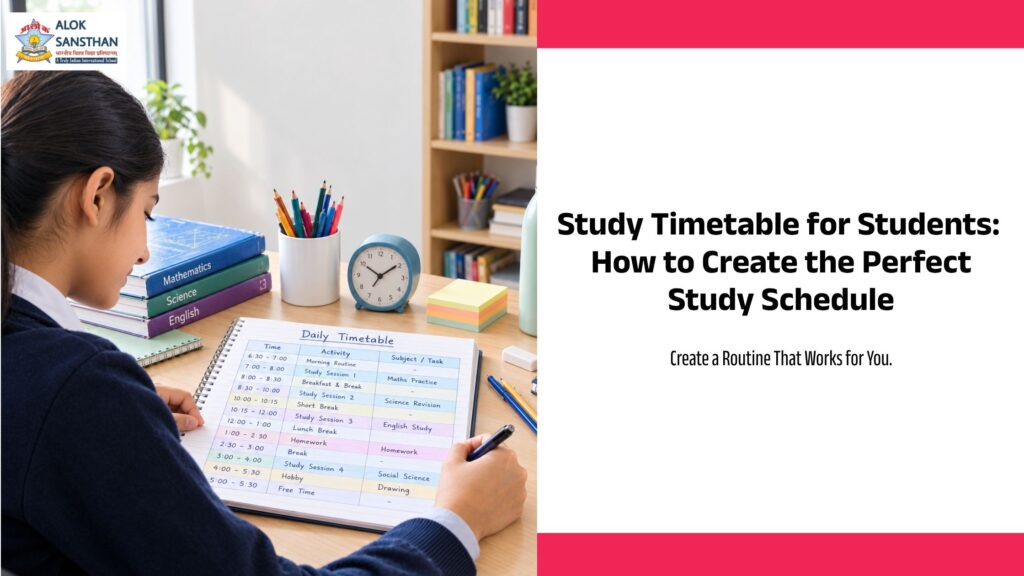
How to Create a Revision Timetable
A good revision timetable should be realistic. If you plan to study for ten hours every day but cannot follow the plan you will soon feel discouraged.
When learning how to make a revision timetable start with the time you actually have.
Keep difficult subjects for the time of day when you usually have more energy. Use shorter study blocks and take regular breaks. Add practice tests and repeated reviews to your schedule.
For example:
| Time | Activity |
| 4:00 to 4:40 | Science active recall |
| 4:40 to 4:50 | Break |
| 4:50 to 5:30 | Mathematics practice |
| 5:30 to 5:40 | Break |
| 5:40 to 6:10 | Social Science flashcards |
| 6:10 to 6:20 | Quick recall of the day’s topics |
You do not need to follow someone else’s timetable exactly. Build a revision schedule that fits your school routine and energy levels.
Do not remove sleep just to create more study time. A tired student may spend more time studying while remembering less.
Common Revision Mistakes Students Should Avoid
Even students who study regularly can make revision less effective by using the wrong approach.
Reading notes again and again: Reading can help you understand a topic but it does not always test your memory. Add active recall.
Starting too late: Last-minute revision leaves little time to find weak areas and practise them.
Spending too much time on easy topics: Easy chapters can feel comfortable. Make sure difficult topics also get enough attention.
Ignoring practice questions: Understanding a chapter does not always mean you can answer an exam question.
Memorising without understanding: Try to understand the idea before trying to remember details.
Studying for very long hours: Long sessions can make it harder to stay focused. Short breaks can help you return with better attention.
Sacrificing sleep: Staying awake all night is not a good revision strategy. Give yourself enough time to rest.
Not reviewing mistakes: Mistakes show where your next revision session should go.
Keeping your phone nearby: Even a quick notification can interrupt your study session. Keep your phone away when you need to focus.
How to Revise the Day Before an Exam
If you have only one day left you need to be selective.
Start with important concepts and topics that you often forget. Review formulas, definitions, key diagrams and mistakes from your practice questions.
Use short active recall sessions. Close your book and check what you can remember before looking at the answers.
These last minute revision tips can help you use your remaining time wisely:
- Do not start every chapter from the beginning.
- Do not spend hours making new notes.
- Do not study through the entire night.
- Do not panic if one topic is still difficult.
- Focus on the areas where your effort can make the biggest difference.
How Parents Can Help Children Revise Effectively
Parents can support revision without turning study time into a source of pressure.
Help your child create a simple routine. Make sure there is a quiet place where they can study with fewer distractions.
Parents can also ask questions such as “Can you explain this topic to me?” This gives the student a chance to use active recall.
Encourage breaks, healthy meals and enough sleep. If your child is struggling with a subject help them find the right support instead of comparing them with other students.
The goal is to help children become more confident and independent learners.
A Simple Revision Formula Students Can Follow
When you are not sure how to revise effectively for exams remember this simple formula:
Learn → Recall → Practise → Check → Repeat
Learn: Understand the topic before trying to memorise it.
Recall: Close your book and bring the information back from memory.
Practise: Solve questions, explain the topic or apply what you have learned.
Check: Look for mistakes and information you could not remember.
Repeat: Return to the topic after some time and test yourself again.
This five-step process turns revision into an active process. It also helps you spend more time on the areas that need attention.
Conclusion: Revise Smarter, Not Just Longer
Knowing how to revise effectively is not about studying for the longest number of hours. It is about using your time well and choosing methods that help you remember, understand and apply what you have learned.
Start with a simple revision plan. Use active recall to test your memory. Use spaced repetition to return to topics over time. Practise questions and past papers to see how well you can apply your knowledge.
Most importantly do not wait until the last night to find out what you have forgotten.
Learn, recall, practise, check and repeat.
With a steady approach and the right revision techniques you can make your study sessions more focused and walk into your exams feeling better prepared.
At Alok Sansthan, students receive the guidance and support they need to learn with confidence and build strong academic habits. Explore our approach to education and see how we help students grow and achieve their goals.
Frequently Asked Questions
1. What is the most effective way to revise for exams?
Use active recall, practice testing and spaced repetition. Do not rely only on rereading your notes.
2. How can I revise effectively in less time?
Focus on weak topics and use active recall, practice questions and past papers.
3. How often should I revise a topic?
Revise it several times with gaps of a few days between sessions.
4. Is active recall better than rereading?
Yes. Active recall tests what you can remember without looking at your notes.
5. How can I make a revision timetable?
List your subjects, prioritise weak topics and add study sessions, breaks and practice time.