



Learning multiplication tables can feel difficult when you try to remember every answer at once. You may know a table when you read it from beginning to end but struggle when someone asks you a question in a different order. For example, you might remember that 6 × 7 = 42 while reading the six times table but take longer to recall the answer during a maths exercise.
This happens because reading a table and remembering an answer without looking are two different skills. To learn multiplication tables more easily, you need to understand how multiplication works, recognise number patterns and practise recalling answers regularly.
You do not have to memorise every table in one sitting. Start with the facts you already know, use them to understand unfamiliar ones and build a regular practice habit.
Why Do Students Find Multiplication Tables Difficult?
Many students try to memorise multiplication tables by repeating them aloud. This can help them become familiar with the answers, but it may not be enough when questions appear in a different order. A student might know a table from memory but still struggle to answer an individual question.
Another difficulty is trying to learn too many new facts at once. Students may also confuse similar facts, such as 6 × 7 and 7 × 8, especially when they are in a hurry.
A lack of revision can create another problem. Learning a table once does not guarantee that every answer will remain easy to recall.
The solution is to combine understanding with practice. Learn a manageable group of facts, understand how the answers are connected and test yourself without looking at a chart.
Understand Multiplication Before Memorising Tables
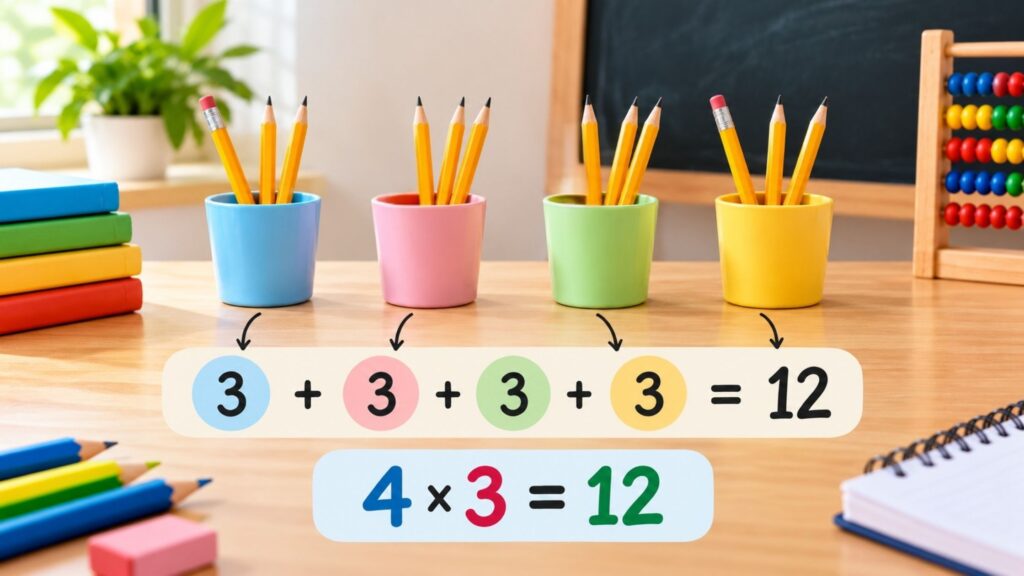
Multiplication is a way to add equal groups quickly. Once you understand this idea, you can use it to work out answers even when you cannot remember them immediately.
Imagine that you have four boxes, with three pencils in each box. You can find the total number of pencils by adding three four times:
3 + 3 + 3 + 3 = 12
You can write the same calculation as 4 × 3 = 12. This means four groups of three contain twelve pencils altogether.
The relationship between equal groups, repeated addition and multiplication is shown below.
| Method | Example | Explanation |
| Equal groups | 4 groups of 3 pencils | Each group contains three pencils |
| Repeated addition | 3 + 3 + 3 + 3 = 12 | Add three four times |
| Multiplication | 4 × 3 = 12 | Find the total using multiplication |
This understanding is useful when you forget a multiplication fact. Instead of guessing, you can think about the groups and work out the total. With practice, you will begin to recall familiar answers directly.
How to Learn Multiplication Tables Step by Step
Trying to learn every table together can make the process confusing. A better approach is to begin with familiar patterns and gradually use them to understand more difficult facts.
Start With the 1, 2, 5 and 10 Times Tables
These tables are useful starting points because their patterns are relatively easy to recognise.
- The 1 times table: Any number multiplied by 1 remains the same. For example, 8 × 1 = 8.
- The 2 times table: The answers are doubles of the numbers. For example, 2 × 6 means double 6, which is 12.
- The 5 times table: The answers end in 5 or 0 when multiplying positive whole numbers by 5.
- The 10 times table: Multiplying a positive whole number by 10 gives the number followed by a zero.
Do not only recite these tables. Look at how the answers change. In the two times table, each answer increases by two. In the five times table, each answer increases by five. These patterns help you predict the next answer and check your calculations.
Move to the 3, 4 and 6 Times Tables
Once you are comfortable with the easier tables, use familiar facts to work out new ones.
The four times table is a good example. Since four is double two, you can double an answer from the two times table to find the matching answer in the four times table.
For example, 2 × 6 = 12. Doubling 12 gives 24, so 4 × 6 = 24.
The same idea works with the six times table. You can double the corresponding three-times answer. For example, 3 × 5 = 15, so 6 × 5 = 30.
These connections make unfamiliar facts easier to understand because you are building on knowledge you already have.
Practise the 7, 8 and 9 Times Tables
Some students find these tables more difficult to remember. Instead of treating every answer as a completely new fact, connect it to something familiar.
For example, if you know 7 × 4 = 28, you can double 28 to work out 7 × 8 = 56. You can also use the nine times table’s number patterns to check your answers.
This learning order is only a suggestion. If you already know the seven times table but struggle with the four times table, focus on the facts you need to practise rather than following a fixed order.
Easy Methods to Learn and Remember Multiplication Tables

Different methods can help with different types of multiplication facts. The important thing is to understand how each method works so you can use it independently.
1. Use Skip Counting to Recognise Patterns
Skip counting means counting forward in equal steps instead of counting one number at a time. It helps you understand how the answers in a multiplication table are connected.
For example, counting in fours gives you 4, 8, 12, 16, 20 and 24. Each answer is four more than the previous one.
Suppose you forget 4 × 6. If you remember that 4 × 5 = 20, add one more group of four. The calculation becomes 20 + 4 = 24, so 4 × 6 = 24.
Try this method with a table you are learning. Notice how much each answer increases and use the pattern to work out a missing fact. As you become more familiar with the table, you can gradually rely less on counting.
2. Change the Order of the Numbers
In multiplication, changing the order of two numbers does not change the answer. This is known as the commutative property of multiplication.
For example:
- 3 × 8 = 24
- 8 × 3 = 24
Both calculations give the same result. If you already remember one fact, you can use it to help remember the other.
Imagine three rows of eight buttons. There are 24 buttons altogether. If you arrange the same buttons into eight rows of three, the total remains 24. The arrangement changes, but the number of buttons does not.
When practising, connect facts such as 4 × 7 and 7 × 4. This helps you recognise that they represent the same total rather than treating them as two unrelated answers.
3. Look for Patterns in the 5, 9 and 10 Times Tables
Number patterns can make certain tables easier to remember and help you check your answers.
In the five times table, the answers alternate between ending in 5 and ending in 0. The first five answers are 5, 10, 15, 20 and 25. Each answer increases by five.
In the ten times table, multiplying a positive whole number by 10 gives a number ending in zero. For example, 7 × 10 = 70.
The nine times table has a useful pattern in the answers from 9 × 1 to 9 × 10. Look at the tens and ones digits in the table below.
| Multiplication | Answer | Tens digit | Ones digit |
| 9 × 1 | 9 | 0 | 9 |
| 9 × 2 | 18 | 1 | 8 |
| 9 × 3 | 27 | 2 | 7 |
| 9 × 4 | 36 | 3 | 6 |
| 9 × 5 | 45 | 4 | 5 |
| 9 × 6 | 54 | 5 | 4 |
| 9 × 7 | 63 | 6 | 3 |
| 9 × 8 | 72 | 7 | 2 |
| 9 × 9 | 81 | 8 | 1 |
| 9 × 10 | 90 | 9 | 0 |
Notice how the tens digit increases from 0 to 9 while the ones digit decreases from 9 to 0. For pattern comparison, you can write the first answer, 9, as 09 to show a tens digit of 0 and a ones digit of 9. However, the actual multiplication answer is 9, not 09.
You can also notice that the digits in each answer add up to nine. For example, 4 + 5 = 9 in 45 and 6 + 3 = 9 in 63. This is a useful way to check the pattern, but it should not replace learning the multiplication facts themselves.
4. Build Difficult Answers From Facts You Know
When you forget a multiplication fact, break it into a calculation you already understand. This gives you a reliable way to find the answer.
Suppose you cannot remember 6 × 7. If you know 5 × 7 = 35, you only need to add one more group of seven.
35 + 7 = 42
Therefore, 6 × 7 = 42.
You can use the same approach with other facts. If you know 8 × 4 = 32, then 9 × 4 is one more group of four. Add four to 32 to get 36.
Try this yourself: if you know 5 × 8 = 40, how would you work out 6 × 8? You would add one more group of eight, giving 40 + 8 = 48.
Over time, repeated practice can help you remember these answers directly.
How to Memorise Multiplication Tables Without Forgetting Them
Understanding a calculation helps you find an answer, but you also need to practise recalling it. Reading a table while looking at the answers is different from answering a question without any help.
Use these three habits to improve your recall.
Practise without looking. Read a multiplication question, say or write your answer and then check it. If you cannot remember the answer, work it out using a method you understand before trying again.
Mix the order of questions. Do not always practise from one to ten in the same sequence. Mix questions from the same table and include a few facts from tables you have already learned.
Return to difficult facts later. Keep a short list of the facts you often forget. Practise them again during your next session and test yourself later to see whether you can still recall the answers.
For example, if you repeatedly forget 7 × 8, use a known fact to work out 56. Write the question on a flashcard, try answering it without looking and check your response. Revisit it during a later session.
Focus on the facts that need more work while continuing to review the tables you already know.
Fun Ways to Practise Multiplication Tables
Practice can include simple activities at home as well as written exercises. These activities work best when you check your answers and learn from any mistakes.
- Flashcards: Write a multiplication question on one side of a card and the answer on the other. Try answering before turning the card over. Keep difficult cards in a separate pile so you can practise them again.
- Number cards or dice: Pick two numbers and multiply them. If you cannot recall the answer, explain how you can work it out using a known fact.
- Quick quizzes: Ask a parent, sibling or friend to give you a short set of multiplication questions. Check the answers afterwards and review the questions you missed.
- Everyday examples: Use multiplication when counting equal groups or calculating a total cost. If four notebooks cost ₹20 each, the total is 4 × ₹20 = ₹80.
These activities make practice more varied and help you use multiplication in different situations.
A Simple Daily Routine for Multiplication Practice
You do not need a long study session to practise multiplication tables. Start with ten focused minutes and use the time for different types of practice.
| Time | Activity | Purpose |
| 3 minutes | Revise a table you already know | Keep familiar facts fresh |
| 4 minutes | Practise a few difficult facts | Understand and improve weak areas |
| 3 minutes | Answer mixed questions without looking | Check recall and accuracy |
During the four-minute session, focus on only a few difficult facts rather than trying to revise every table. Work out an answer if necessary, then try to recall it again without help.
If you keep making mistakes in one particular table, spend more time understanding those facts before adding new ones.
Common Mistakes to Avoid When Learning Tables
Avoid these common mistakes to make your multiplication practice more effective.
| Common mistake | What to do instead |
| Trying to learn too many tables together | Focus on a small group of facts first |
| Only reading the table aloud | Close the book and test your memory |
| Practising questions in the same order | Mix questions from different tables |
| Copying incorrect answers without understanding them | Work out why the correct answer makes sense |
| Spending too much time on facts already known | Give extra attention to difficult facts |
| Learning a table once and never revising it | Return to older tables during later sessions |
If you keep forgetting a particular fact, do not assume that you are bad at maths. Find out what makes the answer difficult to remember, use a suitable method and practise it again.
Check Your Progress With a Short Practice Exercise
Use this exercise to check whether you can recall multiplication facts without looking at a table. Try answering the questions first, then check the answer key.
- 4 × 7 = ?
- 6 × 8 = ?
- 9 × 5 = ?
- 7 × 8 = ?
- 3 × 6 = ?
- 5 × ___ = 40
- ___ × 4 = 28
- 9 × ___ = 63
Answer Key
- 28
- 48
- 45
- 56
- 18
- 8
- 7
- 7
After checking your answers, look at the questions you answered incorrectly or found difficult.
For example, if you struggled with 6 × 8, you can use doubling: 3 × 8 = 24, and doubling 24 gives 48. If you missed 9 × 7, review the nine-times-table pattern and then test yourself again.
Repeat the exercise later with the questions in a different order. Your aim is to improve your accuracy and recall, not simply to memorise the answer key.
Final Thoughts
Learning multiplication tables becomes easier when you understand number patterns and use familiar facts to solve difficult questions. Start with simple tables, practise recalling answers without looking and revise the facts you often forget.
A few minutes of focused practice each day can help you improve your accuracy and become more confident in maths.
At Alok Sansthan, we believe every child deserves quality education and the right guidance to build strong academic foundations. Explore our learning approach and take the next step towards your child’s brighter future.
Frequently Asked Questions
1. How can I learn multiplication tables easily?
Start with the 1, 2, 5 and 10 times tables. Look for number patterns, practise a few difficult facts and test yourself without looking at the answers.
2. How can I learn multiplication tables fast?
Practise for ten focused minutes each day. Use familiar facts to solve difficult questions and spend extra time on the answers you often forget.
3. How can I memorise multiplication tables without forgetting them?
Test yourself regularly, mix the order of questions and revise difficult facts on later days. Regular practice helps you recall answers more easily.
4. How much time should I practise multiplication tables daily?
Start with ten minutes a day. Revise familiar tables, practise difficult facts and finish with a short quiz. Adjust the time according to your learning needs.