


Knowing an answer is only one part of doing well in an exam. Students also need to understand what each question asks, manage their time and present their answers clearly. A student may know a topic well but still lose marks by missing part of a question, writing irrelevant information or leaving an answer incomplete.
Good exam writing is not about filling every page. It is about giving the right information in a clear and organised way.
Whether you are writing a class test, half-yearly exam, annual examination or board exam, having a clear approach can make it easier to complete your paper properly. From reading the question paper to checking your answers before submission, each step has a purpose.
How to Write an Exam Paper Step by Step
1. Read the Question Paper Carefully
Do not start writing as soon as you receive the question paper. First, read the instructions and understand how the paper is arranged.
Look at the marks given for each question and go through all sections carefully. Notice which questions you can answer confidently and which ones may need more thought.
This first reading is also a good time to understand how many questions you need to attempt. If there are choices in the paper, read them properly before deciding which question to answer.
A few extra moments spent reading can prevent mistakes later. It can also help you begin the exam with a clear idea of what needs to be done.
2. Plan Your Time Before You Start Writing
Good time management during an exam does not mean checking the clock after every answer. It means having a simple idea of how much time you can give to different parts of the paper.
Questions carrying more marks usually need more explanation than questions carrying fewer marks. However, do not spend too much time on one difficult question while other questions are still left.
Before you begin, look at the total number of questions, their marks and the time available. This will give you a better idea of how quickly you need to move through the paper.
If you get stuck on a question, leave some space and move to the next one if possible. You can return to it later instead of using a large part of your exam time on one answer.
3. Understand What Each Question Is Asking
One common mistake in exams is answering a question based on what you know about the topic instead of what the question actually asks.
Pay attention to words such as define, explain, describe, compare, differentiate, discuss and give reasons.
For example:
- Define means you need to give the meaning of a term or concept.
- Explain means you need to make an idea clear with suitable details.
- Compare means you need to show similarities or differences.
- Differentiate means you need to clearly point out how two things are different.
- Give reasons means you need to support your answer with suitable reasons.
- Describe means you need to present the main features or details.
Understanding these words can help you decide what kind of answer you need to write.
4. Write Answers According to the Marks
The amount of information in an answer should generally match the marks given to it. A one-mark question usually needs a short and direct response while a question carrying more marks may need greater detail.
As a general guide:
- 1 mark: Give a direct and accurate answer.
- 2 to 3 marks: Give the main points with a short explanation.
- 4 to 5 marks: Give a structured answer with relevant details.
- Long-answer questions: Explain the topic properly and add examples, diagrams or other details when required.
These are only general guidelines. Different subjects and examination patterns may require different approaches.
For example, a two-mark Science question may need two important points while a Mathematics question may need proper working even when the final answer is short.
The aim is not to write more. The aim is to provide enough information to answer the question completely.
5. Structure Your Answers Clearly
A clear answer is easier to read and makes your ideas easier to follow.
For short questions, start with a direct answer. For longer questions, divide your response into suitable points or short paragraphs.
Headings and subheadings can be useful when an answer has several parts. Bullet points can also make information easier to understand when the question asks for multiple points.
Use important terms from the topic naturally. Add an example when it makes your explanation clearer.
Avoid repeating the same idea in different sentences. Writing more does not make an answer stronger if the additional information is not relevant.
For a longer answer, you can begin with a direct response, explain the main points and add an example or conclusion when needed.
6. Use the Right Approach for Different Question Types
Different questions need different answering styles. Understanding this can make it easier to decide how to write an answer.
Short-answer questions
Give the exact information asked for. Avoid writing a long explanation when the question only needs a short response.
Long-answer questions
Divide the answer into clear sections or points. Explain each important idea and add examples or diagrams when they support your answer.
Explain or describe questions
Start with the main idea and then provide supporting details. Make sure your explanation remains connected to the question.
Compare or differentiate questions
Use separate points or a table when it makes the differences easier to understand. Make sure both sides of the comparison are covered.
Numerical questions
Write the formula when required, show the important steps and give the final answer clearly. Include the correct unit where needed.
Diagram-based questions
Draw a clear diagram and label it properly. A diagram should support your answer rather than simply fill space.
Objective questions
Read each question and option carefully before selecting an answer. Do not rush through objective questions simply because they appear easier.
7. Keep Your Answer Sheet Neat and Presentable
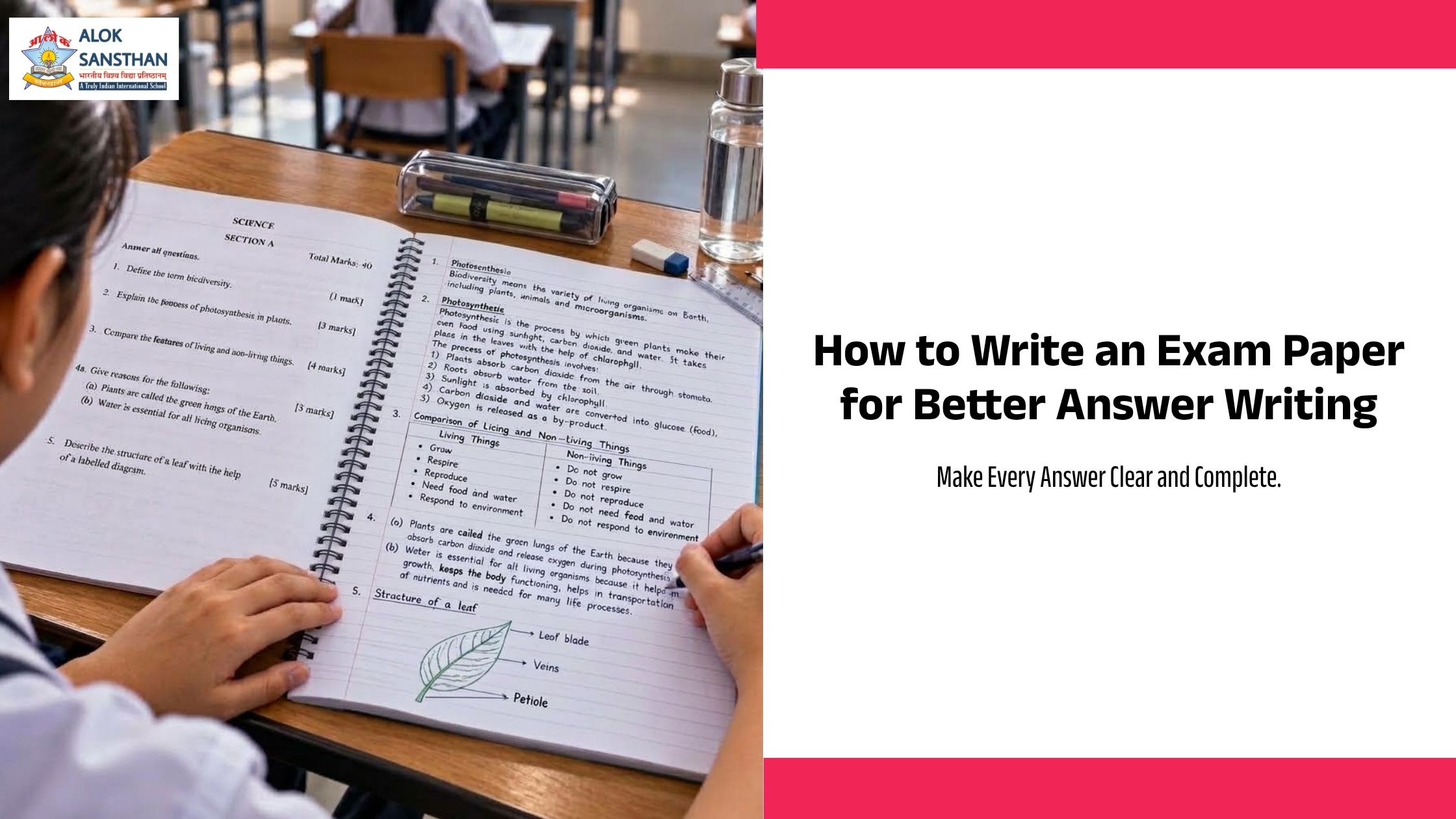
Good exam paper presentation is not about making your answer sheet decorative. It is about making your work clear and easy to follow.
Write in a way that can be read comfortably. Maintain reasonable spacing between answers and follow the question numbering given in the paper.
Use headings when they improve clarity. You can underline important terms when useful but avoid underlining every sentence.
If a diagram, table or flowchart can make your answer easier to understand, use it where suitable. Make sure diagrams have clear labels.
If you make a mistake, cross it out neatly and continue writing. Avoid repeated corrections that make the page difficult to read.
These simple paper presentation tips can improve the overall appearance of your answer sheet without taking much extra time.
8. Follow Subject-Wise Answer Writing Practices
The right way to write an answer can vary from one subject to another.
Mathematics
Do not write only the final answer when working steps are expected. Show important calculations and formulas clearly. Check your calculation and include units where required.
Science
Explain concepts clearly and use correct terms. Add labelled diagrams when a question requires them or when a diagram can make the answer easier to understand.
Social Science
Use headings and points for questions with several parts. Include relevant dates, facts and examples. Use maps or diagrams when the question asks for them or when they genuinely support your answer.
English
Follow the required format for letters, notices, essays and other writing tasks. Pay attention to grammar, spelling, sentence formation and the logical flow of your ideas.
The same answer-writing style may not work for every subject. Always give priority to what the question requires.
9. Avoid Common Exam Writing Mistakes
Many exam mistakes happen because students are in a hurry or do not check their work properly.
Some common mistakes include:
- Starting to write without reading the question properly
- Answering only one part of a question
- Writing too little for a question carrying more marks
- Adding unnecessary information
- Spending too much time on one question
- Using incorrect question numbers
- Leaving an answer incomplete
- Forgetting units in numerical answers
- Drawing unclear diagrams
Poor presentation can also make an otherwise good answer difficult to follow. Keep your handwriting readable, maintain proper spacing and organise your answers clearly.
When you know how to write in an exam, you are less likely to lose time on avoidable mistakes.
10. Keep Time for Final Checking
Try not to use every available minute for writing. Leave some time at the end to check your answer sheet.
Start by looking for unanswered questions. Then check whether you have attempted every part of the questions you answered.
Review your question numbers and make sure your answers are placed correctly. In Mathematics and Science, check formulas, calculations and units. Look at diagrams to make sure all important labels are complete.
For language subjects, check spelling and grammar where possible.
You can also look for answers that you started but did not finish. A final check gives you a chance to catch mistakes that you may not notice while writing.
Final Thoughts
Learning how to write an exam paper is not about writing the most or writing the fastest. It is about understanding what each question asks and presenting the right information clearly.
Read the question paper carefully, manage your time according to the paper and write answers that match the marks and question type. Use headings, points, examples and diagrams when they genuinely improve your answer.
Neat answer sheet presentation also makes your work easier to follow. Most importantly, keep a few minutes for final checking.
Good exam writing means making sure your knowledge is presented clearly, accurately and completely.
Prepare better. Write smarter. Learn with confidence.
At Alok Sansthan, we focus on strong learning, clear thinking and overall development so students are ready to face every academic challenge with confidence.
Frequently Asked Questions
1. How to write an exam paper properly?
Read each question carefully, manage your time, write answers according to the marks and keep your answer sheet neat and organised.
2. How to write answers in an exam?
Understand what the question is asking, give the relevant information and structure longer answers with clear points, headings or short paragraphs.
3. How to write an exam paper neatly?
Maintain readable handwriting, proper spacing and correct question numbering. Use headings, underline important terms and keep corrections neat.
4. How should I manage time while writing an exam?
Divide your available time according to the marks and number of questions. Avoid spending too long on one question and keep a few minutes for final checking.
5. How can I avoid losing marks in an exam?
Read questions carefully, answer every part, follow the required format, show working where needed and check your answer sheet before submission.